Showing posts with label Morocco. Show all posts

Friday, November 21, 2014

Bread and Cheese

Bread and cheese and butter. Mascarpone and ricotta and akkawi. Laban and labneh. Granola and qatayef and turkish delight. Dips and sauces, jams and juices, sweets and treats and snacks. Pantry loaded with homemade goods, freezer stocked up with overflow, and fridge beaming with colors and flavors.

qatayef
It all started in Ifrane earlier this year.

I had always been a home cook enjoying eating in rather than dining out. I liked to experiment with different cuisines and throw ingredients together to see what I could come up with. I rarely followed a recipe and didn't need much space to move around in. I made some Lebanese, some Asian, some American, some Italian, but didn't venture too far out of my comfort zone. There were some dishes that I was reluctant to try, hesitant to put the time and effort into, weary of the energy it was going to take me to put them together not trusting that they would turn out as I would expect.

In Ifrane, while a whole new world of flavors and ingredients opened up to me, I did not open up to it; at least not at first. I stuck as much as I could to "mainstream" cooking throwing together meals I was familiar with working with ingredients I knew. My repertoire of recipes shrunk significantly as I could not find the "exotic" ingredients that were at my disposable in the US. Of course in hindsight much of what was available to me in "quantities" and for "pennies" in Ifrane is considered "exotic" in the US. Who needed coconut milk when you had preserved lemons? Who needed taco seasoning when you had ras el hanout? But I didn't know. I tread very carefully down the Moroccan culinary lane and produced only a handful of traditional dishes, and even less desserts.

Turkish delight
Then I went to Lebanon. And returned. And when I came back my eyes opened.

I saw women who couldn't read or write, let alone follow recipes, put forth exquisite meals. They baked bread, cookies and cakes. They made pizza, chicken nuggets, and fish sticks. They fermented yogurt, pickled olives and juiced oranges. Everything they possibly could, they made at home. They did not have any fancy kitchen equipment, signature cutlery, or a wide open kitchen space. There weren't any graduated cups or spoons, no exact oven temperatures and no food thermometers.

I was left wondering. If these women could turn out a cake without exact measurements, why can't I? And that was the spark I needed.

With that thought I broke through my barriers and expanded my cooking comfort zone. Soon enough I was making fresh farmer's cheese, cakes, bread and pasta. I realized you really did not need an exact cup of flour to make bread, and that even a failed cake is good enough to eat. Every day I put forth a three-course dinner and was left wanting to cook some more.

pasta
Then we came back, and I reunited with my measuring equipment, my electric devices, my designer pots and pans. I decided to carry on with my culinary adventures and expand my offerings. And with imported ingredients easier to find around here I was able to move forward with my plans. I now make quite a few varieties of fresh cheeses, yeast breads and semi-sweet desserts. I feed Yousef homemade granola and Jannah-Rae loves homemade butter on toast. And while it certainly is easier to buy yogurt ready made from the store, it is more fun and more rewarding to serve the one made at home.

laban
And with my new experiments come less cravings. Knowing that I can make qatayef in under an hour and that hot pita bread is not beyond my capabilities, I feel less homesick for Beirut. That I can now have akkawi and labneh for breakfast and toum with dinner, I no longer feel like I need to "import" them when I visit Lebanon. I have become semi-self-sufficient. And I trust that my family is eating well. My only regret is not having more family to share my creations with!


Monday, August 18, 2014

Canned Spinach

My first, and last, meal cooked with spinach from a can happened one beautiful winter morning. It was Ifrane; quiet, secluded, removed from the plenitude of choices and crammed aisles. I was struggling over what to feed two kids who were used to variety, to availability, to certain meals cooked in certain ways. I was losing sleep over how malnourished they will be, how they are going to lack in vitamins, how their iron levels are going to drop, how little calcium they were getting, how stunted their growth was going to get. As any mom I was anxious to make sure they were well provided for, nourished, satiated. Little did I know then that the brisk, clean air, the hours spent outdoors, the ample locally sourced, seasonal produce, the slow pace and quiet, mixed with home-cooked meals served with love, was worth more than anything I could find on shelves and in freezers. But I learned.  

I had known about canned spinach from watching Popeye the Sailor Man as a child but I had never actually come into personal proximity with it. I had always had either fresh or frozen spinach. Always that is until we moved to Morocco. Then, anxious to provide the kids with iron rich vegetables and having few options to chose from I resorted to the imported canned greens. They were not inexpensive, as after all they were imported and I had my reservations about the product. I was not entirely disappointed, however, and managed to make a couple of meals out of one can. The taboo over using canned spinach was hence forever removed from my mind. Given a choice, of course, I would have opted for something different but under the circumstances it was the best I could offer my family. And if I had to do it all over again, I would; this time without losing any sleep. 

That meal was cooked on a gas stove, in aluminum pots, using plastic spoons. Rice with ground beef, onions and spinach. Flavored with allspice and lemon juice. Cooked in olive oil with a tad of salt. Simmered in chicken broth made from organic chicken carcass bought from the chicken monger at the marché. The kids not only gobbled down the meal, JR even asked for more. It was not a royal meal of any sort but it was splendid enough for my family and me. 

Wednesday, February 19, 2014

Eat well; Spend little ~ Ifrane

What would you expect to pay for a three-course home-cooked meal out? 8$? 10$? 15$? 20$ How about the equivalent of 3$!

On Monday, the kids and I met Jeff downtown to take care of an issue at the bank. I had thought that the matter would take a few minutes and so I left the apartment unequipped with snacks for the kids. Unfortunately, minutes turned into an hour and before you know it the kids were hungry and I was left wondering what to feed them. There were few options to pick from in the vicinity where we were, unless we wanted to leave the establishment smelling like cigarette smoke, or overpaying for a less-than-average tasting pizza. We decided to see if we could find a cab that would drive all four of us together; apparently there is a rule that a taxi can only take three passengers at one time, although many drivers decide to break that rule as they see fit. Luckily we found one that agreed to cab us all back to the compound where an apartment turned restaurant was located.

We had heard about the Faculty Club as soon as we arrived in Ifrane. However, we had always preferred to dine at the snack bars and faculty restaurant on campus rather than eat at the one down the street. For one, we were never sure about its hours of operation, it was a hassle to juggle the bus schedule with office hours and work requirements and finally I had always wanted to get away from the monotony of my immediate surroundings. Lately, however, and considering the weather, proximity and a desire to try new things have been prompting us to seek pleasures close by. We thus marked our first visit to the Faculty Club which left us hungry for more (no pun intended!)!

We were greeted by the owner of the place, who also serves as the waiter, the cashier and the bus boy. All the tables were beautifully set with red tablecloth, cloth and disposable napkins, water glasses, forks, spoons, and knives; missing were the disposable place mats and kids coloring mats, this was a fancy affair. A water bottle refilled from the tap sat in the center of the table and around it stood upholstered chairs on one side and comfortable cushiony couches complete with throw pillows on the other; there were no high chairs or boosters for the little ones. A television broadcasting the news in Arabic filled the air along with the voices of other diners speaking in Korean, English, Darija and French.

Once seated the food was immediately served; missing were the six-page colored coded, finely described, attractively photographed menus. The ladies in the back cook whatever is fresh that day over an open gas flame in a huge pot and serve it hot and aromatic. There is no prep work, no reheating, no waiting for orders to be issued for food to be cooked. Everything is ready and served on a first-come first-served basis; just like at grandma's house. A hearty soup, or salad, followed by the main course, then fruits and yogurt. Finally a steaming hot glass of Moroccan mint tea with so much sugar it puts sodas to shame to wash it all down. Moroccan bread is laid out alongside the food with which to clean off the plates. The menu is fixed and so is the price: meat one price, chicken another. That is all the choice you get in the matter, and that is all the choice you need!

we had split pea soup, and
beef, bone-in tagine with preserved lemons, green olives, and potatoes.

Oh! I forgot to mention: no tip was necessary, or expected!

Tuesday, February 18, 2014

Ten Dollars of Produce in Ifrane

While we do not typically buy our fruits and vegetable at the marché, lately, and because of the cold weather, we have found ourselves choosing convenience and speed over price and variety. We found a grocer we connect with who usually stocks up on fresh produce over the weekend, who cuts us a good price and who bags the best of what he has for us rather than giving us the day-olds. He is gentle and kind with the kids and usually offers them a pear, a banana or an apple at the end of the transaction; one for each! At one time he even offered us what lemons he had left at no cost. 

Last Saturday we went on our usual fruit and veggie restocking trip and returned home loaded with purples, yellows, reds, oranges and greens ~ both in edibles and cash; all we had spent was 80 MAD. 

Here is what the equivalent of 10$ bought us:

~ 1 kilo* of babanas
~ 1/2 kilo of strawberries
~ 1 kilo of grapefruit
~ 1 kilo of mandarins
~ 1 kilo of navel oranges
~ 1 kilo of pears
~ 1 kilo of potatoes
~ 1.5 kilos of onions
~ 1 kilo of tomatoes
~ 1/2 kilo of fresh green peas, hulled
~ 1 kilo of lemons
                     
and we even rounded up the cost to the advantage of the grocer!


        * 1 kilo equals 2.2 pounds

Friday, February 14, 2014

Gratitude List ~ Ifrane

It is after midnight and I have been thinking about all the things "good" about life in Ifrane. A gratitude list reflects what my family and I have been blessed with and what I am thankful to have experienced. 

~ sit down breakfasts and family dinners
~ beautiful sunrises and colorful sunsets
~ clear blue skies and white clouds
~ fresh air, both cold and refreshing
~ winter snow, summer breeze
~ long days and short nights
~ radiant heat, both comforting and sweltering
~ tank tops in the middle of winter inside, all bundled up outside
~ all the hot water I can use, supplied at a low cost
~ full moons on clear nights and rays of sunshine through the fog
~ the downstairs neighbor and their trusty nanny
~ time alone with Yousef and shared playtime with JR
~ homemade meals that are entirely made from scratch
~ cooking with no recipes, baking with no exact measurements
~ breads and cakes and yogurts
~ pancakes and french toast
~ improvising with what is available; doing the best with what is on hand
~ no ready snacks, no processed foods
~ flexible schedules; late departures and early returns
~ lunch dates and afternoon walks
~ dinner parties and tea sippings
~ seasonal vegetables all fresh and cheap
~ mint and parsley at 25 cents a bunch
~ pomegranate, persimmons, figs and quince that are not luxury
~ artichokes, fresh peas, and fava beans; all the eggplant and beets I can eat
~ lemons that juice, bananas and grapes from down the road
~ fresh eggs bought by the one, placed in plastic bags
~ a butcher, a chicken guy and a produce seller who cut me a special price
~ a gated community; a safe place to play
~ sleeping with doors unlocked; trusting the apartment to a stranger
~ the sounds of the athan floating through the air
~ helpful hands around each bend
~ time to write, read, cook and play
~ daily showers, baths, sink cleanups
~ a stronger marriage, a happier family
~ a little boy and a not-so-little anymore girl
~ a wonderful husband, and a supportive family
~ healthy kids, fit and energized
~ rosy cheeks colored by the outdoors
~ friends in the distance
~ few distractions, no obligations
~ little to do and no where to go
~ a lot of peace and a lot of quiet; no horns, no bells, no sirens; no rings or tone; no planes and no trains
~ the green, the blue, the white
~ life that is basic, simple, and unobstructed
~ living focused on the here and now, on the immediate and important
~ life as it is meant to be lived
~ a sleepy town in the Atlas mountains; a little town lost in time, sitting at the edge of the map.


Thursday, February 13, 2014

Morning

Every morning I wake up to a beautiful sunrise. I take a moment to notice, then I take another to capture. I have set an intention to photograph as many of these as I can before I leave Ifrane. Here is one from Tuesday. 


Friday, February 7, 2014

Where we "hang out"

When it was nice outside, the kids and I spent a lot of time outdoors. As small as this town is, there still happens to be a "down town" area where people gather, sit at coffee shops, sip Moroccan mint tea, dine and even dance. Yes! there is a pub/club in town and if you happen to live at the university downtown residence then you are up all hours of the night from the sounds coming from the adjacent facility. There is even a liquor store near the club (gasp!) and a few drunk Moroccans can be spotted outside on a Saturday evening.

A few banks have branches there, as does Maroc telecom. You can find the town's only un-wified cafe, a couple of barber shops and hairdressers, and small souvenirs shops. There is a pharmacy or two, and a couple convenience stores called "supérette". A couple of "Moroccan-style" hotels, and an expensive Western-style resort/spa, are located within a few meters from the center of town. There is a small open space consecrated for trade shows and presentations, and a handful of water fountains that run during the warm season, but which are fenced all around to prevent accidents.


To the people who live in Fes and Meknes, the two closest cities to us, Ifrane is the weekend destination. It is a mountain town with plenty of green spaces, water fountains, and a pedestrian enclosure where the kids can roam free, feed the pigeons and pick flowers. In the winter, they come here in droves to look and play with the snow and spend the day as local tourists.


To the international tourists, Ifrane is a stop on their way to Marrakesh on their scenic mountain-road drive. They stop for the day, having passed the royal palace on their way in, dine at one of the cafes, take photos in front of a famous lion stone sculpture, whose story and history are a cause for interest -  the popular story of its origins involves an Italian inmate who reportedly sculpted it out of limestone - and then continue on their way.

To us, it is another place to hang out when we are tired of our gated community, the campus and the road in between. We do not see ourselves as "tourists" and so we have not yet captured the moment in front of the statue. Some weekend days we walk there and enjoy breakfast outside, others we head over in the afternoon on the bus or by foot and let JR run around the water fountain and play with other kids. One time we even "dined out" on pizza at one of the restaurants, and while the outing itself was fun, sitting indoors surrounded with smokers was not much fun. We decided to stick with "eating-in" since then.


Only once did I attempt to head there with the kids during this winter season and that was the first and last time; the kids and I had to sit at the coffee shop all dressed in our winter gear. When I mentioned this to a friend, I understood that it is common practice for the cafes and restaurants to be unheated even in the coldest of weathers; it costs too much to heat these places up. The workers just bundle up and the clients are expected to do the same. If the sun is shining and the wind not blowing, which so far has proved to be a rarity, the customers sit outside, still all bundled up. The luxury of a warm indoors is reserved for the houses and you have a choice: the comfort of your home or the change in scenery coupled with the cold at the cafe. For me the choice was easy!

Friday, January 31, 2014

Our apartment ~ with Ranya's touches

I have previously given a tour of the apartment where we live. All four of us are tucked away in a one-bedroom apartment with a three-quarter bath. For months we have been making the best of a rather small space that is only getting smaller as the kids are getting bigger, and in the past few weeks I have found myself challenged my managing the space.

We have added more toys acquired in Beirut for JR's birthday, a walker for Yousef now that he is mobile and a pack-and-play for Mama's peace of mind while she is cooking. The space saver high chair has found its place on a borrowed desk chair and the extra "dining" chair has since become a stool for JR to reach the bathroom sink. I consolidated the boxes we had shipped and brought us down to two boxes that are situated in our "living room." The suitcases have either been stuffed into a useless closet, under a humongous side table, or behind the bed. Our shoes have relocated to the outside of our apartment and are tucked away in a dresser and are sharing the hall space with the rest of our boxes containing donation items. I had spotted others making use of the common space to store household items beyond bikes and trikes and roller blades and thought to do the same. After all we only have so much room to move.


Jeff and I share the one closet that has shelves; he has one and a half shelf and I have one shelf. Yousef's car seat takes up the bottom part of the closet and our towels and sheets and stroller blankets take up the remaining half shelf. The other closet has a bar for hangers and it contains Jeff's work pants and shirts as well as JR's car seat. On its shelf sits the gym bag and yoga mat. Yousef and JR share the one dresser that we have, each taking up one and a half drawer. We have two other drawers dedicated to our hats, gloves and scarves as well as bibs, baby towels and other odds and ends. We finally got around to having enough hooks for our bath towels and PJs. We are still in search of a coat rack but I am comfortable tucking our big jackets unto the floor of the closet in an effort to keep clutter at a minimum. And we are yet to solve the problem of dirty laundry piling up behind the door. The radiators have been serving me well as drying racks for wet mittens, gloves, socks, and underwear.


The kitchen has also acquired a few extra utensils in the past few weeks but it has been easy to find storage for them; after all I only have a handful of pots and an equal number of plates and bowls and cups. We still do not own a cutlery organizer as none of the ones we have found fit in the narrow drawer that exists. So, our forks and knives and spoons take up the first shelf in the two kitchen cabinets that sit on top of the sink. My new rolling pin, the cake pan and the tea pot that we bought after returning from Lebanon have joined the rest of my appliances either underneath the sink or on top of the stove. The electric toaster oven that took months to arrive sits on top on a TV stand that has been converted to a fruit and vegetable caddy, and its top has become a place for the multitude of water bottles and cups that we use throughout the day. We also bought a fruit bowl for the table in an effort to make eating fruit more accessible.


The multitude of food items that I brought back from Lebanon with me stand as my pride and joy. The two kilos of Tahini, the Falafel mix, the Magi soup, the Instant noodles (yes, we eat processed foods and I am not about to defend my food choices), the pasta (yes, I brought pasta with me but that is another story for another time), the Pomegranate Molasses, the Rose Water, the Cafe Najjar, the Zaatar, the Nido, the spices and the sweets, the candy and the cookies, and others have been stored front and center in my pantry. I reach for them often and I am so glad I found a way to bring them along. I had to leave a bunch of clothes, a pair of shoes, and a couple of toys behind in Beirut to make room for the food but at the end of the day I am certain I made the right decision. These consumables and perishables are for the time being my most valued possessions.

I reorganized the one shelving unit that we own and created more space for odds and ends to be thrown in there. I moved the hazards away from Yousef's reach and created a shelf for JR's homeschooling material. The fireplace that is of little use to us with a toddler and a 4-year old has been transformed into a toy storage area and I used an extra sheet to cover up its guts. Our broom and dust pan stand in one corner by the fridge and our trash can has been moved to its top. Yes, I put the trash on top of the fridge to keep it away from the curious reach of Yousef. Of course I could have put it in the cabinet underneath the sink, which may seem the most logical place for it, but that space is taken up by our extra bottles of locally produced sparkling water and our UHT milk.


JR has assisted in "decorating" the place by placing stickers on the walls as she pleases. I gave her complete artistic freedom in choosing the stickers and their locations. I hung up my "phone book" alongside the intercom that does not work on top of the dresser that houses the kids' clothes and that takes up half the hallway. We bought a night-light in Beirut and super-glued it to the outlet by the bathroom door and outside the bedroom as it kept falling out. JR climbs on top of the drawers to reach it and turns it on at every nap and bed time. We also bought a few outlet covers from Beirut in an attempt to baby-proof the place and have used only a couple seeing how few outlets we actually do have. I took down the lamp shades to make the place brighter, much to Jeff's chagrin as he thinks exposed bulbs are dangerous.


The place is feeling a little more "together" than it was a few months back but it still feels like just a "place." It needs a lot of work to render it more comfortable and "decent." The broken couches still need to be replaced, the walls need a fresh coat of paint, the woodwork needs repair, the windows need weatherstripping, among other defects that need to be addressed. But for the time being we are making do. We are number 7 on the wait list for a 3 bedroom apartment and number 11 for a 2 bedroom. I see it as highly unlikely that we will be here in time to move to any of the other options, seeing how there is no formula to when or how the movement happens and how our moving to Ifrane was never a permanent move. So, until we are able to head back to America, I will continue doing the little things that make me want to hang out in this apartment and continue trying to make it feel warm and welcoming and "uncluttered."

Tuesday, October 22, 2013

The way we roll

We are not new to not having a car. When we lived in Portland, OR, we decided to sell the car the summer we got married. When we moved to VA we were without wheels for over a year and made great use of the public transportation system. Of course it had its faults and many times we were not impressed by the operation but we lived and worked within walking distance from the metro station and really had little need for a car. When we wanted a change in scenery we rented a car from across the street and spent the weekend in discovery mode. Then we had a real need for reliable transportation and invested in our first major purchase as a family. CR-V Mike made its way into our life and became integral to it. We moved back and again to VA and the car tagged along. Luckily we were never utterly dependent on CR-V Mike and could always get around with it as we now find ourselves back at square one with transportation: car-less!

When we made the decision to move to Ifrane we were told time and again that we needed a car. We debated shipping our own, but ran into laws against it. We thought we would try getting around without one. We, after all, had options when it came to transportation. This is how we roll around here:

Our feet:
 
This is by far the most reliable, although not the quickest, mode of getting around town. Since there is not much to do and a lot of time not to do it, many times I find myself walking to and from destinations. Some times JR walks along, other times she rides in the stroller or on my back. During this season the morning part of the day is usually sunny and warm so we do the majority of our walking then. It gets windy in the afternoon so we avoid being in the open air then and revert to transportation choice number 2.

The university shuttle bus(es):


The university has a fleet of buses to serve its faculty and staff. There is an array of buses ranging in sizes from vans to tour buses that are deployed to take people around town. They stop at the various university residences, the marché, and other areas depending on the time of the day and the requests of the passengers. Yes, although the buses have a fixed route to follow the drivers take on-board requests and change the route accordingly without previous warning or explanations. On several occasions the kids and I found ourselves being taken around town to that end. One time we, along with a bus-full of people, waited while someone walked up to their apartment, picked up something they had forgotten and got back on the bus. That person was not even faculty at the university! Another time we found ourselves being taken the "scenic" route and ended up in an accident with a car.


Some days we are the only ones on the bus, and on others we are crowded together and hear the driver asking people, usually the students to deboard. When there is enough room, the drivers pick up locals on their way and drive school children to their homes.

The buses follow, or rather do their best to follow, a posted schedule or schedules, which makes it confusing to remember. There is one schedule for the weekday and another for the weekend, one for faculty, another for staff and a third for students. There are also buses for each of these categories although many times everyone is seen piled into the same bus. The buses are many times late, and some times early so we end up either waiting too long or missing it altogether. Sometimes more than one bus come at the same time and once there were three stopped at the same "station."

We find ourselves spending a lot of time at the bus stop but time is of abundance here.


The petite taxi:


These are the go-to mode of transportation to get around town. They are clearly visible in their green color, their marking "petite taxi" (if you look closely you can read that along with the number of the cab on the front door), and their topper.

They roam almost everywhere and all you have to do to catch one is hail them. The places they do not roam are inside the university, and at the annex residence, where they are prohibited to enter. You could call for service, though, and they will arrive. Once you find a cab driver you can communicate with he becomes your go-to-person. You exchange phone numbers and he takes care of your transportation needs.

It usually costs between 15 and 25 MAD to get around town whether it is one person or car-full. And when I say car-full that ranges between 3 and 5 persons depending on the mood of the driver that day. There seems to be a fluid insurance law that dictates there can only be 3 passengers to a car. That is the equivalent of two to three and a half US dollars. You could tip the driver but that is not expected.

The grande taxi:

 These are five passenger Mercedes-Benz turned seven passenger to maximize income. They are the method of transport for the maids and the nannies who live across town. The ones we have seen in Ifrane are old, rickety and dirty. The bumpers are falling off, the paint is chipped and the car is held together with masking tape. But if it rolls, it is driven.

 
These taxis are used inter-cities. You take it from the gare routière, or the equivalent of Union Station. To get there, you either employ your feet or hail a petite taxi (see above). They are for long distances, whether your destination is the next town, which is about 20 minutes away, or the ones further out which are an hour or more away.

If you are lucky you are a family of six and can command the entire vehicle. If you are not, then you choose your fate: either be sandwiched between three other strangers in the back or be wedged between the stick shift and the second rider in the front. Or, you could pay for the entire cab and get comfortable. The cost depends on where you are going but everyone must pay, including lap babies. The journey in those cars end at the counterpart gare routière where again you either take a petite taxi or walk to your final destination.

Friends' cars:

There are two types of cars in Morocco: these with yellow tags and those with white tags.

 
The yellow tags are reserved for foreigners, diplomats and such. They are hard to come by and in great demand by the expat community. These cars cost less that their counterparts as they are exempt from taxes. Once you locate one to purchase, and at times you have to travel internationally and drive one back, you go through a lot of red tape, make numerous trips to this office and that and spend many hours trying to navigate the process. The money you save on cost, you spend in your time. But once you are done with the process you are rewarded with not being too harassed by the police when you infringe on the driving laws, which, by the way, are quite vague.


The white tags belong to the locals. These cars are abundant and easy to buy but they are usually more expensive considering the amount of taxes that are tagged on them.

Rented cars:

There are no car rental agencies in Ifrane. We reached out to the one in Azrou, the major town next door. A colleague of Jeff's emailed us the contact information of a man who works in the business. We got in touch. There were no emails exchanged, no paperwork filled out, no credit card information given out. The entire transaction was conducted by phone and word of mouth. We indicated the dates, he detailed the cost. He trusted we are good for our money; we trusted he was good on the car. We did not know him, and he did not know us. We did not see the car until the day it was dropped off. Secretly we wondered if he would remember, or even show up!

We traded a few phone calls up until the day. He showed up! He showed up early. We met in person, negotiated a little. He took the cash. He took my Lebanese passport. We took the car. As simple as it. One item of value for another. We had wheels. He had business. It was the beginning of a beautiful renting relationship. Apparently he is the only agent who offers door-to-door service.


Other modes of transportation:

bicycles; notice the "no" helmet
 
the "moped"
 
a school bus

the university courtesy golf cart to wiz you around

Saturday, October 12, 2013

Lamb and Quince Tagine ~ a Moroccan Classic

I have been here over a month now and all I hear about is tagine this and tagine that. Every time I go to the butcher and ask for a cut of meat, he asks if it is for tagine. Until yesterday I always responded with a "no."
 
The day had come when I decided to try tagine for myself. I had finally acquired all the right spices to make the concoction. I had bought quince at the souk the previous week thinking I would ripen it and eat it as s fruit like we do in Lebanon but they were starting to rot before they ripened. I decided to throw them in a pot and call it a meal, just like my Moroccan neighbors.
 
I asked around and learned verbally the method of cooking and the necessary steps. I followed that with some online research and verified the process. Then I set to work. I eliminated the fat other than olive oil, took out the sugar, and adjusted the salt. I played around with the seasoning and came up with an adequate mix.
 
I peeled, cored and cut the quince. I boiled them and sweetened them. I let them stand. I worked with the meat and adjusted the spices. I tasted it often to make sure I was on the right track. I let it sit in the juices at room temperature until dinner time. I bought fresh bread, reheated the separate pots gently and served.
 
It was a good first effort. JR loved the meat broth and ate it as a soup, Jeff soaked it up with bread. I enjoyed the quince and marveled at JR's sense of adventure with new foods. I have nothing to compare my meal to, not having tasted it elsewhere, but I can say that what I served qualified as delicious.

Ingredients:  


  • 1 kg (about 2 lbs.) beef or lamb, cut into 2" or 3" pieces
  • 2 medium onions, finely chopped
  • 3 to 4 cloves garlic
  • 1 or 2 cinnamon sticks
  • 1 1/2 teaspoons ginger
  • 1 teaspoon salt
  • 1 teaspoon turmeric
  • 4 tablespoons olive oil
----------------------------------------------------------------------------
  • 1 1/2 kg (3 lbs.) quinces
  • 1 teaspoon honey
  • 1 teaspoon cinnamon
  • 1 cup water
 

Preparation:

Cook the Meat

Heat the olive oil in a heavy-bottomed pot or a pressure cooker. Add the meat, onions, garlic, and remaining spices. Stir to mix well, and brown the meat over medium-high heat.

Add 3 cups of water. Cover, and cook with pressure for about 45 minutes or until the meat is very tender. Reserve 3 to 4 tablespoons of the broth, and reduce the remaining liquids until the sauce is thick and mostly oils.


Cook the Quinces

While the meat is cooking, prepare the quinces. Peel them, cut them into eighths, and core them.
Transfer them to a pot. Cover with water and bring to a boil. Simmer gently for 15 to 20 minutes, or until the quinces are tender but still firm enough to hold their shape.

Drain the quinces, reserving several tablespoons of the poaching liquid. Add the reserved broth,  cinnamon and honey. Bring to a simmer and cook until a thick syrup forms. Occasionally stir or turn the quinces to coat them with the syrup on all sides.


To Serve

Place the meat and sauce on a serving platter. Arrange the quinces all around, spooning the syrup over the meat and fruit. Serve with crusty bread to soak up the juices.


Friday, October 11, 2013

A day in Ifrane

My days here start like they did back home: in the kitchen.

I wake up and the first thought that comes to mind is "what's for dinner?" The next is "how about lunch?" Only later do I think of what I want to have for breakfast. Only after everyone is taken care of do I begin to think of myself.

I put a pot of milk on the stove to warm it up. I add a little sugar and what is an inadequate replacement to my Godiva hot chocolate mix. I stir and pour it into a mug. It sits there until it gets cold. I get carried away with the washing and the chopping. I tell myself every day that this morning I will sit, enjoy my drink hot, and read or write or just sit. But that day is yet to come to me here like it had yet to come to me there. If I am lucky, the kids stay asleep past the early hour that wakes me up. Otherwise I am joined by two little ones and their chatter and requests.


Once the meal is put together and simmering, I move on to breakfast. Most day the menu consists of either hard boiled eggs or oatmeal. Some days I make raisin-apple couscous or even pancakes; but those days have been rarer. On the weekends there are omelets, lentils or chickpeas with lemon juice, garlic and olive oil or we go out for chocolate croissants and Moroccan bread.

If it is a "school" day (and I use school here with an immense stretch to the term), usually Mondays, Wednesdays and Thursdays, JR's snacks are next. A Kiri sandwich with honey, three animal crackers in a plastic box, three gummy bears in another box, yogurt and a spoon, and maybe a fruit: an apple or banana. JR fills up her own water bottle and assembles the "lunch bag": a reusable Babies R Us shopping bag. In between I make sure Yousef is fed and changed and Jeff's lunch and fruit are packed.

 
The early morning activities are concluded with a load of laundry, hand-washed and line-dried. We have a line out on our balcony but over the weeks that I have been here I noticed the laundry taking days to dry there; we do not get any sun there. So I chose to carry the load down the stairs and around the building and make use of the communal line; it gets plenty of sun and I get my dry clean laundry the same afternoon rather than the next day. Of course it adds to my "commute" but we all have to make choices!


The sun has now risen and it is around 7:30. I sweep the floor and if Jeff is ready and has time to watch the kids I wet mop on my hands and knees (we have not yet purchased a long-handled squeegee). I open the windows to dry the floor and move on to another task. I take out the trash or bring it down with me when I take JR to "school", Yousef to the marché, or the laundry to the line.


I am almost done with housework. There is always more housework! Lunch needs to be prepared; diapers need to be changed; dishes need to be washed. The beds are hardly ever made; there is always someone sleeping or sitting on them and so it is futile for me to "make my bed." Maybe one day when the bedroom seizes to double up as a living space I can have attractive "made" beds with soft sheets and fluffy comforters and decorative pillows.


The day is now in full force. We meet up with friends, we take a walk, we play in the playground, we take the bus to campus, we hang out at the apartment. We wait for Yousef to wake up from his morning nap. We go to the neighbor's house. We Skype Teta, have lunch, take a nap, Facetime Grandma. If it is a Tuesday, we spend the afternoon at the university picking leaves and flowers and playing with the mud. If it is a Friday, we have lunch with Baba at the faculty restaurant. If a Saturday we go to the souk. On Sunday we get bored! We invite people over for dinner. I stress out over the cooking! Some days JR goes to the neighbor's house for play dates; some times I join her, others I just drop her off. Some days friends come over to our place to hang out; these are rare.

Some days I write while the kids nap. Other days I cook. Some days I nap. A handful of days I read a book. The days go by.

Jeff comes home from work. The table is already set and dinner is almost ready. I toss the salad, pour the olive oil and vinegar onto the plate, serve the main dish. We sit down to eat, alternating who eats with one hand while holding Yousef with the other. Some dinners Yousef joins us, other times he plays with the plastic spoon. Some evenings he watches us from his play mat. Dinner is over. The table is cleared. The dishes pile up in the sink.


Bath time is next, if it is bath day. Some days it is shower only, others it is straight to PJs. On bubble bath days, Yousef and JR share the fun in the tub. Hair wash days are still dreaded, but they are few and far in between. Pajamas, story time, a little more play time, a "show" on the iPad and then time to go to sleep. I nurse Yousef to sleep, snuggle with JR and then most days I drift off myself. Others I get up, spend time with Jeff, do the dishes if he has not gotten around to them, try to enjoy one last warm drink and head to bed.

I fall asleep almost immediately only to be awaken several times during the night to nurse Yousef, walk him around the apartment or pat him back to sleep. The other times I wake up are to take JR to the bathroom or use the facilities myself. Then all of a sudden it is another day and the cycle begins again.

Sunday, October 6, 2013

Our walk

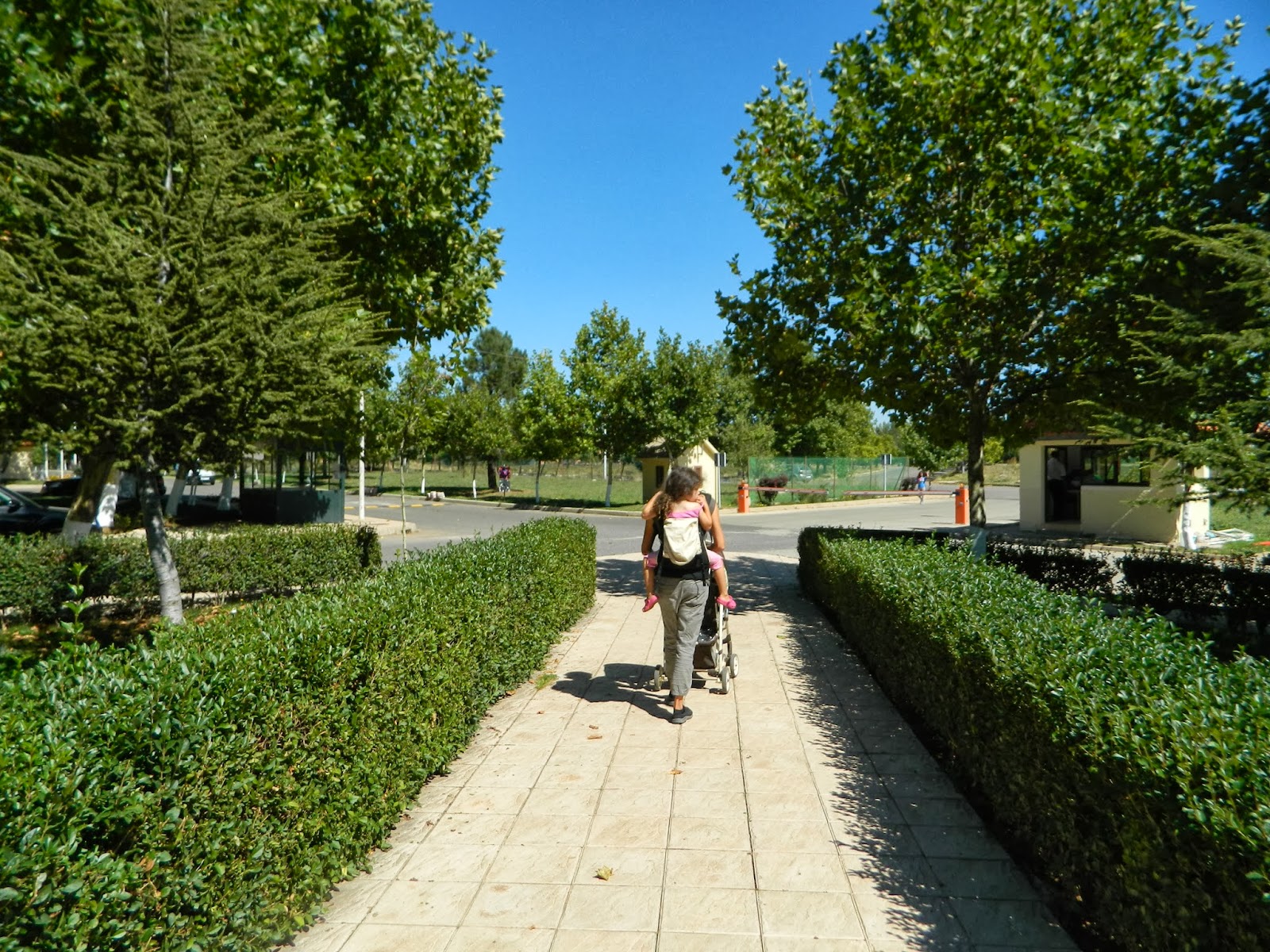
I promised to take you shopping with us. But before we get to where we are going, we need to walk. Get dressed, put your walking shoes on, strap one kid to your chest, or back, put the other in the stroller and meet us downstairs. The time is not set in stone; it is often a range usually between 9 and 9:15 but sometimes the walk does not start until 9:30. But hey, what's the rush? It's not like there is anything else happening around here!
 
Everyone is here and ready, so let's go. Look up at the sky: it is sunny and clear, another beautiful Fall day in the "country."


Out the gates and onto the roads the first thing you notice are the young trees. There is not much shade, if any, on some streets in this town. Consequently, the kids and I spend a lot of time in the sun, much to my detriment. I try to remember the sunscreen but most often it is forgotten at the bottom of my backpack. Our family is probably the only one that uses it and so I seem to have gotten out of the habit of slathering it on. Fortunately for us, the sun is not very hot these days, as it is the Fall, but I wonder what it would be like during the long summer days. I will have to remember to use it then.


The other thing you notice is the sidewalk and crosswalk situation: some roads have them and some do not. More often than not the kids and I find ourselves walking amidst the cars and praying that we do not get run over. I make that choice at times because I find it easier to push the stroller on the paved street than having to maneuver it up the high sidewalk and down again every time I need to cross the street or dodge a narrow passing.


There are some sidewalks that magically disappear too; now you see it, now you don't. So I avoid the disappointment and just take the road. I honestly do not think that the urban planner had mothers with strollers in mind when designing the streets around here, but I could be wrong.


The crosswalks are a hit or miss and so again, the kids and I find ourselves pretending to be cars and making our way through them crossing sideways in the middle of the street to get to where we are going.


Our walk is rather short and usually uneventful. Some days we are accompanied by the stray dog, others we find ourselves alone: few people are seen around during the day and the roads are not totally busy with cars. We pass a corner amass with men; these are the day laborers waiting to be picked up.


Many times we meet up with other moms in the community and walk. Whether anyone needs something at the marché or not we walk; there is little else to do. Usually, however, someone is shopping for something. Sometimes we are offered a ride from a faculty member going to work late, we decline; it is the journey we are after not the destination.

Along the way there are a few construction sites. Some people like it here so much that they are building their own houses from scratch. The builders use mortar, concrete blocks and bricks here; there are no prefabricated wooden material and sheet rock. They use tree trunks to hold the ceilings up and orange tubes for electrical wirings. It will be rather interesting to watch these houses grow from the ground up.


There are also many abandoned houses; some complete and others left while still a work in progress. It makes me wonder why these projects are dropped. I hear it is really expensive to heat these houses up in the winter so I guess that either the people tried them out and thought better or just ran out of money upfront.


There is also trash and animal waste along the way. Sheep, horse and donkey leftovers can be seen on any given day. Entire bags of trash or just empty bottles, napkins, yogurt containers are strewn here and there. As you approach the marché, you can even spot a skull or a skeleton or two.

 
We are now halfway to our destination. It takes around 15 to 20 minutes to get where we are going. If I am "hustling" I can do it in 10 minutes but I am usually out for leisure. At this point in the walk, JR consistently asks about a landmark that seems to be consistently closed: a fair-type playground. You have to pay to enter the grounds but the gate is never staffed and the hours are not listed so it is difficult to try and plan an outing there.
 
 
A few steps past the playground JR yanks me out of my daze to point to something far up on top. "Animals," she points. I am not sure what she is talking about. Look up, though, and see what we see.
 
When you are done trying to figure out why someone would perch wild animals on top of a hill, look to the other side of the street and marvel at the carvings on the wall. I wonder how these came about but admire the work it took to leave a mark there.
 
We are now approaching our destination. Over the curb, down a step, and around the corner. Look for the ramp and stride inside. We are here. Next we will take a look inside.